How to Build Home Equity Faster in Western Springs, IL (2026 Guide)
The short answer. In Western Springs, four levers build home equity, and they are not equal. Appreciation is doing the heaviest lifting — MRED MLS data put the trailing twelve-month detached median at $995,000 through July 2026, up 13.2% year over year. A Cook County property tax appeal is the fastest win you actually control. Targeted renovation comes third. Extra mortgage payments come last.
Key Takeaways
- The trailing twelve-month median sale price for a detached Western Springs home was $995,000 through July 2026, up 13.2% year over year — roughly $116,000 in appreciation over twelve months, per MRED MLS (ConnectMLS) closed-sale data.
- Western Springs appreciated at roughly twice the rate of the wider Chicago metro, where the FHFA House Price Index rose 6.20% year over year in Q2 2026.
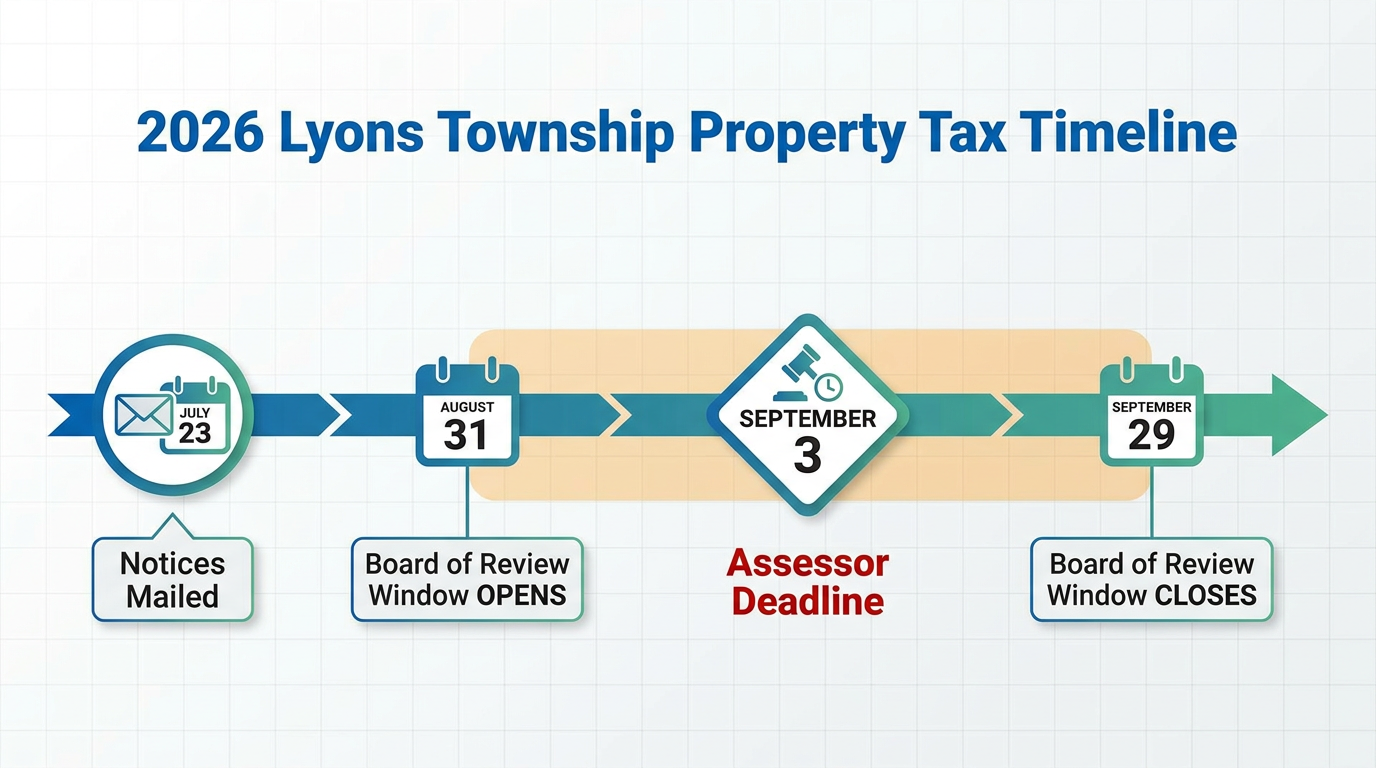
- The Cook County Board of Review appeal window for Lyons Township is open from August 31 through September 29, 2026, and you may file even if you missed the September 3 Assessor deadline.
- Western Springs’ effective property tax rate runs roughly 1.45%–1.60%, and West Cook News reported a median annual bill of $14,354 against a $875,000 median home value in Q4 2025.
- About 89% of the village’s roughly 4,544 housing units are detached single-family homes, with a median year built around 1960.
- Garage door replacement recoups roughly 90–95% of its cost, making it one of the highest-return improvements available on older housing stock.
- GoBankingRates ranked Western Springs the #1 safest and richest city in the United States in 2025.
You own a home in Western Springs. You have watched its value move — on your assessment notice, in conversations at Grand Avenue Community Center, in the number a website flashes at you when you look yourself up at eleven at night. Now you want to know what actually accelerates equity versus what merely feels productive. The thesis of this guide is simple and slightly contrarian: the biggest levers are not the ones most articles lead with, and the most urgent one has a deadline attached to it that expires this month.

The Cook County Appeal Window That Is Still Open Right Now
Yes, you can still appeal your assessment. The Cook County Assessor’s filing deadline for Lyons Township was September 3, 2026 — but the Cook County Board of Review is a separate and independent body with its own calendar, and its Lyons Township window is open from August 31 through September 29, 2026. If you believed that missing the Assessor’s date locked you into three years of an inflated number, that belief is costing you money right now.
This is the most time-sensitive section of this guide, so it comes first. Everything else here will be just as true in March. This will not be.
Western Springs is in Lyons Township, and 2026 is a reassessment year
Cook County does not reassess every property every year. It splits the county into three groups and reassesses each on a rotating three-year cycle — the triennial. Lyons Township, which contains Western Springs, sits in the South & West Suburban group. The prior cycles landed in 2020 and 2023. This year is the next turn of that wheel, and reassessment notices were mailed on July 23, 2026.
Here is what “triennial” means in plain English, stripped of the civics-textbook register: the county has just formally re-set the assessed value of your home, and that new number is the foundation for your tax bills until the next cycle. It is not a one-year inconvenience. An error introduced in July 2026 does not quietly correct itself in 2027. It compounds, bill after bill, until the next reassessment — unless somebody challenges it.
That is the part homeowners underweight. A reassessment year is not simply the year your taxes might go up. It is the year the terms are set. The cost of ignoring a bad number is not one bill; it is three years of bills.
The Board of Review is not the Assessor
This is the load-bearing fact of this entire section, and it is the one most homeowners get wrong.
The Cook County Assessor and the Cook County Board of Review are two different offices performing two different functions. The Assessor values property. The Board of Review, established under the Illinois Property Tax Code, hears appeals of those valuations — and it is independent. It is not bound by what the Assessor decided. It does not treat the Assessor’s determination as a settled matter it must defer to.
A homeowner may file an appeal with the Cook County Board of Review even if they never appealed to the Assessor. Missing the Assessor’s deadline does not forfeit your right to be heard.
Read that twice if it is new to you, because the practical implication is significant. The September 3 date that passed yesterday was not the gate. It was one of two gates, and the second one is standing open until September 29.
Now the part a trustworthy advisor says without being asked: the Board may affirm your assessment, it may reduce it, or it may increase it. That last possibility is real, it is not hypothetical, and no honest professional will tell you otherwise. An appeal is a request for review, not a coupon. In practice, the homeowners who fare well are the ones who arrive with genuine evidence — recent comparable sales, documented condition issues, demonstrable errors in the property characteristics on file, such as square footage or bathroom count that does not match the house as it actually exists. The ones who fare poorly are the ones who arrive with a feeling that the number seems high.
Evidence is the whole game. Which is why the value question comes before the filing question.
What happens after a Board of Review decision
The Board issues a written decision. From the date of that decision, a homeowner has 30 days to petition the Illinois Property Tax Appeal Board, commonly called PTAB — a state-level body that reviews assessment determinations independently of Cook County.
Know the boundaries of what PTAB can do before you consider that route. PTAB has jurisdiction over assessed valuation. It has no jurisdiction over tax rates, over tax bills themselves, or over exemptions. If your complaint is that your bill is too large because the levy went up, PTAB is not the venue. If your complaint is that your home is valued above what it would actually sell for, that is squarely within its authority.
That distinction matters more than it sounds. A great deal of homeowner frustration about property taxes is really frustration about rates and levies — decisions made by taxing bodies, not by assessors. The appeal process addresses one variable: whether the county’s read of your home’s value is defensible. It is a meaningful variable. It is not the only one.
Check your exemptions while you are in there
The appeal is the event. Exemptions are the thing people forget — and unlike an appeal, they are not a judgment call. They are either applied to your bill or they are not, and a surprising number of Cook County homeowners discover an eligible exemption sitting unclaimed.
Three worth confirming:
- The Homeowner Exemption reduces your home’s equalized assessed value (EAV) by $10,000. Be careful with how you interpret that figure — it is a reduction in assessed value, not a flat dollar discount on your bill. What the reduction is worth in actual dollars depends on your local composite tax rate. Those are two genuinely different things, and they get conflated constantly. The Cook County Assessor’s Homeowner Exemption page is the authoritative reference.
- The Senior Citizen Homestead Exemption reduces EAV by $8,000 for qualifying owners.
- The Low-Income Senior Citizens Assessment Freeze carries a household income limit of $75,000 or less for tax year 2026. Details and qualification criteria are on the Assessor’s Senior Freeze page.
Pull out your most recent bill and read the exemption line. The Cook County Treasurer’s office is where you can see how exemptions actually appear against what you owe. It takes about four minutes, and it is the highest hourly-rate work available to a Cook County homeowner on a given Tuesday.
Why this is an equity lever, not just a tax topic
Here is the connection that makes this a section in an equity guide rather than a civics lesson.
Western Springs’ effective property tax rate runs roughly 1.45% to 1.60%. West Cook News reported a median Western Springs tax bill of $14,354 against a median home value of $875,000 in Q4 2025. Those are not small numbers, and they are not one-time numbers.
Every dollar of an over-assessment is a dollar that never reaches your principal.
That is the whole argument. Money routed to an inflated tax bill is money that could have gone toward the mortgage balance, toward a renovation that raises market value, or toward an index fund. It is not merely an expense — it is a permanent diversion away from the equity side of your balance sheet, recurring annually, for as long as the bad number stands. A successful appeal does not produce a one-time refund and disappear. It resets a recurring outflow. Compounded across a triennial cycle, that is real money that stays inside your household’s net worth rather than leaving it.
And because an appeal is fundamentally an argument that your home is assessed above its market value, it requires something specific: a defensible read on what your home is actually worth. Not a website estimate. A supportable number, built from comparable sales in your actual comp tier, that would survive scrutiny. If you do not have that, request a home valuation before you file — it is the raw material the entire appeal is built from, and it is the same input every other lever in this article depends on.
Please verify before you rely on any date here. Appeal windows in Cook County are township-specific and they change from year to year. Confirm current deadlines directly against the Cook County Assessor’s calendar and the Board of Review before acting.
Colleen Wilcox is a licensed real estate broker affiliated with Compass. She is not a tax attorney, CPA, or mortgage lender. This is general information only and is not legal, tax, accounting, or lending advice. Consult a qualified professional about your specific circumstances. No appeal outcome is guaranteed.
Having covered the fastest lever you control, it is worth stepping back to see where a tax appeal actually sits relative to everything else on the list.
The Four Equity Levers, Ranked by What They Actually Pay
In Western Springs, the four levers that build home equity, ranked by dollar impact, are appreciation, a successful property tax appeal, forced equity through targeted renovation, and accelerated mortgage paydown — in that order. Most guides on this subject present that list backwards, leading with extra payments and treating market movement as background noise. In a village where the typical detached home now trades near $1 million, that ordering is not just imprecise. It is misleading.
1. Appreciation — the largest lever by a wide margin
According to closed-sale data from MRED (Midwest Real Estate Data), the regional multiple listing service for Chicagoland, the trailing twelve-month median sale price for a detached single-family home in Western Springs was $995,000 through July 2026 — up 13.2% year over year.
Sit with the arithmetic for a moment. The same series put the trailing median at roughly $878,750 twelve months earlier. That is approximately $116,000 of equity added over twelve months — accrued by a homeowner who did nothing at all. Who made no extra payments. Who remodeled nothing. Who simply owned a house in Western Springs and let the calendar advance.
Now the necessary caveat, stated plainly because the alternative is dishonest: that is what the market did, not a promise of what it will do. Real estate markets move in both directions. A 13.2% year is a data point about the past, not a projection, and nobody — including anyone with a license — can tell you what the next twelve months hold. Any professional who offers you a forecast dressed as a fact is selling something.
What the figure does legitimately establish is proportion. It calibrates every other lever in this article. Once you know that the market moved roughly $116,000 in a year, you have a yardstick against which to measure whether your effort is going somewhere useful. That yardstick is the point of this section, and the ongoing local read behind these numbers lives in The Wilcox Reports 2026.
2. A property tax appeal — the fastest controllable win
Appreciation is the largest lever, but you do not control it. The tax appeal is the fastest lever you do.
Against a median Western Springs bill in the $14,000 range, a meaningful reduction produces recurring annual savings — not a one-time rebate, but a lower baseline that persists across the triennial cycle. And critically, it is the only item on this entire list with a hard deadline attached. Renovations can wait until spring. Extra principal payments can start any month. The Board of Review window closes September 29, 2026, and then it is gone.
Urgency and impact rarely land on the same lever. Here they do.
3. Forced equity — the lever you actually control
Forced equity is the value you manufacture rather than receive: targeted improvements that raise market value by more than they cost to execute. It is the only lever where your judgment, rather than the market’s mood or the county’s calendar, determines the outcome.
It is also the lever where the most money gets wasted, because the right projects in Western Springs are not the right projects nationally — a consequence of the village’s housing stock that Section 5 takes apart in detail.
4. Accelerated paydown — real, but small
Now the honest comparison.
An aggressive extra-principal strategy — an additional payment each year, or a few hundred dollars monthly toward the balance — typically moves your equity position by a few thousand dollars over twelve months. Set that against roughly $116,000 from appreciation over the same twelve months.
Appreciation did in twelve months what an aggressive extra-payment strategy would take many years to match. That is not an argument against extra payments. It is an argument about proportion.
Extra payments are genuinely worth making. They reduce total interest paid over the life of the loan, sometimes substantially. They shorten your path to the 20% equity threshold where private mortgage insurance can typically come off. They build a cushion against a market that does not always cooperate. And there is a real, non-trivial psychological value in watching a balance shrink — financial behavior is not purely mathematical, and a strategy you will actually maintain beats an optimal one you abandon.
But they are not the headline, and presenting them as the primary equity strategy for a Western Springs homeowner misallocates attention. If you have finite time and finite energy this month, the ranked order above tells you where to spend it. File the appeal. Then direct whatever the appeal saves you toward principal.
Most equity advice is written for a national average that does not exist anywhere — and it exists least of all in a village where the typical detached home approaches seven figures. The advice has to fit the market it is given in.
That appreciation claim rests on market data, and market data has to be read carefully. So let us look at the actual numbers and, more usefully, learn to read the differences between them.
What the Western Springs Housing Market Data Actually Says
Depending on which measure you consult, Western Springs home values look like $995,000, $1,000,000, or a 6.20% regional trend. All three are correct. They differ because they measure different things over different time windows — and understanding why is more valuable than picking a favorite.
The numbers, with sources and dates
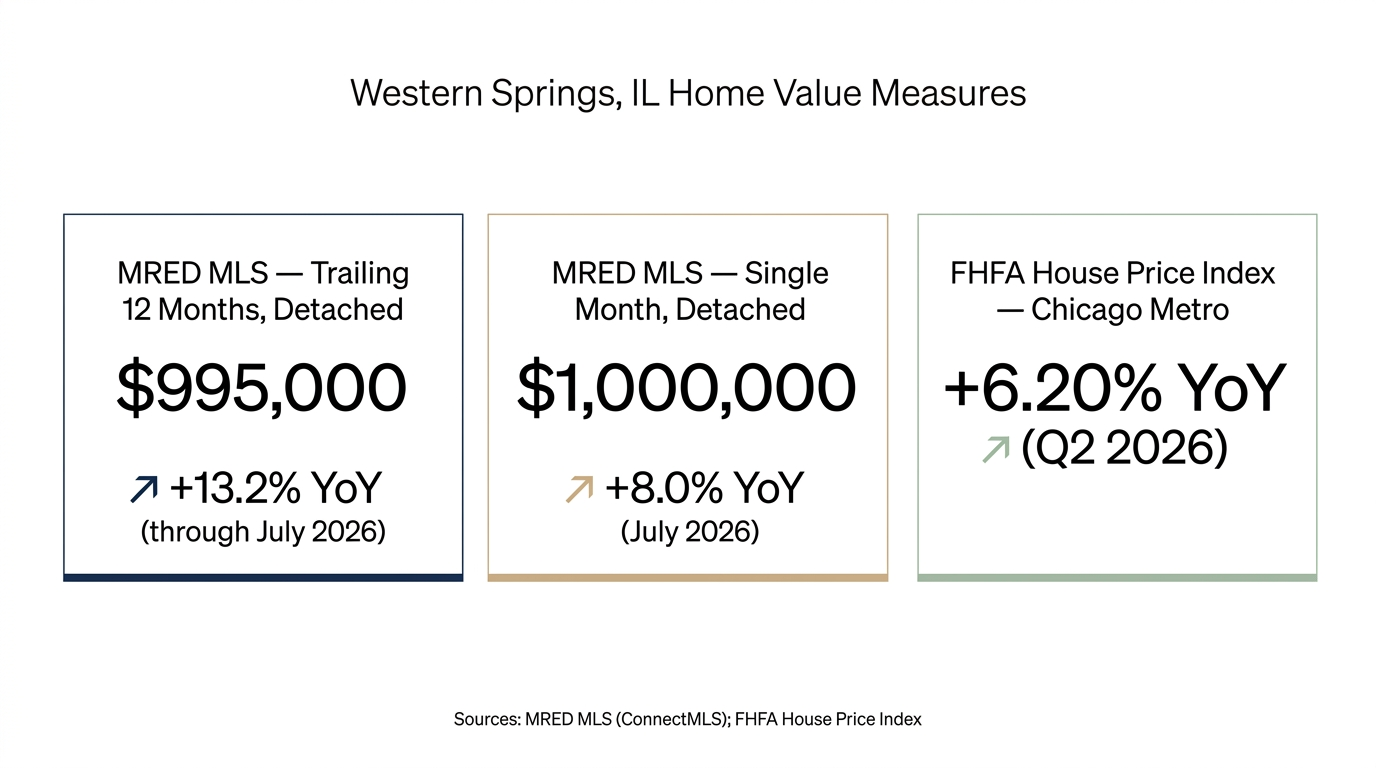
- Detached median sale price, trailing 12 months: $995,000 — up 13.2% year over year. Source: MRED MLS (ConnectMLS), period ending July 2026.
- Detached median sale price, single month: $1,000,000 — up 8.0% versus July 2025. Source: MRED MLS (ConnectMLS), July 2026.
- List-to-sale ratio: 102.2% — detached homes selling above asking price on average, trailing 12 months through July 2026. Source: MRED MLS.
- Detached closed sales: 189 — trailing 12 months through July 2026. Source: MRED MLS.
- Chicago metro appreciation: 6.20% year over year — Q2 2026. Source: FHFA House Price Index, Chicago MSA.
- Effective property tax rate: approximately 1.45%–1.60% — local effective rate range, 2026.
- Median annual tax bill: $14,354 — against a $875,000 median home value. Source: West Cook News, Q4 2025.
Sources and dates as noted. Figures current as of publication.
Why the figures differ — and how to read them
Two variables explain the entire spread, and neither involves anyone being wrong.
The first is the observation window. The $995,000 figure is a trailing twelve-month median — it smooths a full year of closings into one number, which makes it the steadier instrument. The $1,000,000 figure is a single month. In a village that recorded just 189 detached closings across an entire year, a single month is a very small sample, and small samples swing hard on the mix of what happened to close. If three exceptional properties on large lots settled in July, the monthly median jumps — and it will settle back when the mix normalizes.
This is why the single-month figure deserves the most caution. A monthly median crossing $1,000,000 is a milestone worth noting, not a trend worth extrapolating. Anyone quoting one month of data in a thin market as a growth rate is either misunderstanding it or hoping you will.
The second is what is being measured. MRED reports actual closed transactions from the multiple listing service — real houses, real contracts, real prices. The FHFA House Price Index does something different: it is a repeat-sales index, tracking price changes on the same properties over time across the Chicago metropolitan area. That methodology is deliberately immune to mix shift, which is precisely the flaw that distorts short-window medians. It cannot tell you what a Western Springs house costs, but it is an excellent read on the underlying direction of regional values.
Here is where the comparison becomes genuinely informative. Western Springs detached homes appreciated 13.2% over the trailing year. The Chicago metro as a whole, measured by FHFA’s repeat-sales index, appreciated 6.20% in Q2 2026. Different instruments and different geographies, so this is a directional comparison rather than a like-for-like one — but the gap is wide enough to be meaningful. Western Springs is not simply rising with the regional tide. It is outpacing it.
The genuinely useful skill is not knowing which number to quote. It is knowing what each number measures, and choosing the one that matches the question in front of you. For a sense of regional direction, FHFA is the steadier instrument. For “what is a house like mine currently selling for,” the trailing twelve-month detached median in your specific price tier is far more relevant. For pricing an actual listing, none of these is sufficient — you need genuine comparable sales.
If you want to see what those medians look like as real houses on real streets, the current listings are the concrete version of the abstraction.
Why equity compounds in Western Springs
In 2025, GoBankingRates ranked Western Springs the #1 safest and richest city in the United States, a finding covered by Chicago Agent Magazine on September 5, 2025. The ranking evaluated average household income, home values, cost of living, and property and violent crime rates.
A ranking like that is easy to treat as a bumper sticker. It is more useful understood as a description of mechanism — the reasons demand here has proven durable rather than cyclical.
School quality anchors a specific and reliable buyer profile: families who make relocation decisions on a multi-year horizon and who do not exit at the first sign of market softness. Low crime functions as an insurance policy on demand, protecting the buyer pool during periods when discretionary purchasers pull back. Constrained supply is the quiet structural factor — Western Springs is essentially built out. There is no meaningful greenfield inventory arriving to absorb new demand, so demand expresses itself in price rather than in volume. And commuter access to Chicago, via BNSF service from the Western Springs station, keeps the village connected to a metropolitan employment base far larger than the local one.
The MLS data puts numbers to that last point. Just 189 detached homes closed in the trailing twelve months through July 2026 — that is the entire annual supply of the village. And detached homes sold at 102.2% of list price on average, meaning the typical transaction closed above asking. Scarcity plus competition is not a narrative here; it is visible in the transaction record.
Those fundamentals are why appreciation here has tended to compound rather than merely fluctuate. Not a guarantee — nothing in this section is a guarantee — but a description of the underlying structure, which is more than a headline ranking provides. For readers weighing options across the western suburbs, Western Springs generally prices in conversation with its neighbors, and it is worth understanding how it compares to Hinsdale, Burr Ridge, and Oak Brook before assuming any one of them is the obvious answer.
The housing stock explains everything that follows
According to the CMAP community data snapshot for Western Springs, the village contains roughly 4,544 housing units, of which about 89% are detached single-family homes. The median year built is around 1960.
Break the age distribution apart and it becomes considerably more interesting:
- 23.2% built before 1940
- 48.8% built between 1940 and 1969
- Only about 8.7% built in 2010 or later
Add the first two figures. Roughly 72% of Western Springs housing predates 1970. Nearly a quarter of it predates the Second World War.
That single statistic reshapes the renovation conversation entirely, and it is the reason the next section departs from standard national advice. When three out of four homes in a village were built before 1970, the improvements that generate return are not the improvements a nationally-written guide will recommend. The renovation math here is genuinely different — and the difference is worth real money.
How to Calculate the Equity in Your Western Springs Home
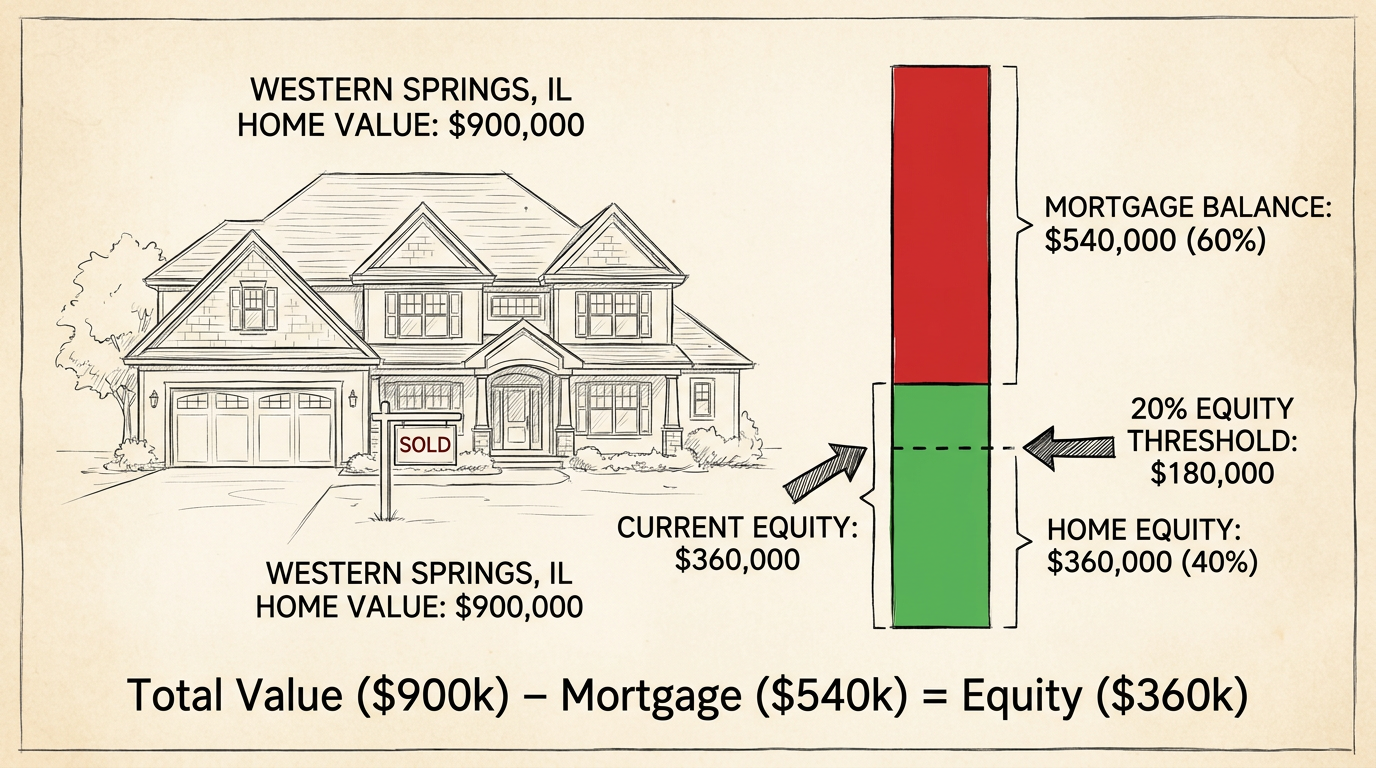
Home equity is your home’s current market value minus everything you owe against it. On a $900,000 Western Springs home carrying a $540,000 mortgage balance, that is $360,000 in equity. The formula is the easy part; getting the value input right is where the actual difficulty lives.
The formula
Current market value − outstanding mortgage balance (plus any second mortgage, home equity line of credit, or lien) = home equity.
Note the parenthetical, because it is where people miscalculate. Equity is measured against every claim on the property, not just the first mortgage. A home equity line of credit you opened during a kitchen project in 2019 and have half-forgotten counts. A second mortgage counts. A contractor’s lien, a tax lien, or a judgment lien counts. If it attaches to the property, it subtracts.
Homeowners routinely overstate their equity by a five-figure sum simply by forgetting a second-position balance. Pull statements for everything secured by the house before you run the number.
A worked example on a $900,000 Western Springs home
Here is the calculation performed step by step. The $900,000 figure is a round number chosen for clarity — it sits a little below the current trailing detached median, which makes it a reasonable stand-in for a great many Western Springs homes:
- Current market value: $900,000
- Outstanding mortgage balance: $540,000
- Home equity: $900,000 − $540,000 = $360,000
- Loan-to-value ratio: $540,000 ÷ $900,000 = 60% LTV
- Equity as a share of value: 100% − 60% = 40%
Those last two lines are worth understanding, because loan-to-value is the language your lender uses. LTV is simply the share of your home’s value that is still financed. A 60% LTV means the lender’s claim covers 60% of the property’s worth and yours covers the remaining 40%. Lower LTV means more of the house belongs to you — and it is the number that governs how lenders price and qualify nearly everything.
The 20% threshold and why it matters
There is one specific line on the LTV scale that carries outsized financial consequence: 20% equity, equivalent to 80% LTV.
That threshold is where private mortgage insurance typically becomes removable. PMI is the premium a borrower pays to protect the lender against default — it delivers zero benefit to the homeowner paying it, and on a loan of Western Springs size it can represent a meaningful monthly figure. Eliminating it is a permanent reduction in housing cost that frees cash for principal, renovation, or anything else.
Run the math on the same house. Twenty percent equity on a $900,000 home means a mortgage balance at or below $720,000.
Now notice something that reinforces the entire argument of this guide: appreciation, not just payments, moves you across that line. The threshold is a ratio, and a ratio has two terms. You can reduce the numerator by paying down the balance, or the denominator can rise as the market moves — and in a year when the detached median moved 13.2%, the denominator did considerably more work than most payment schedules would. A homeowner who bought with a modest down payment and never made a single extra payment may nonetheless have crossed the 20% line, purely on market movement, without noticing.
Which means it is worth checking. If you have not calculated your current LTV recently, you may be paying for insurance you no longer need.
One important qualification: PMI removal rules and timing vary by loan type and by servicer. Some loans permit removal on request once the threshold is documented; some require a specific seasoning period; some require a lender-ordered appraisal at your expense; and certain government-backed loan products handle mortgage insurance under entirely different rules that may not permit removal at all. Confirm your specific situation with your lender rather than assuming the general rule applies to you.
Why “market value” is the hard variable
Everything above depends on one input, and it is the one nobody can look up with certainty.
The formula is trivial. The value is not. An online estimate is a starting point and a genuinely useful one — but it is a statistical model, not an appraisal, and it should not be the basis for a tax appeal, a renovation budget, or a listing price.
Automated models work by finding patterns across large volumes of comparable transactions. They perform best where housing stock is homogeneous: subdivisions of similar age, similar square footage, similar finish level, transacting frequently. That is precisely the opposite of Western Springs. Here, a 1920s original with its plaster and its original casings might sit three doors from a 2018 rebuild, on a block that also holds a well-maintained 1960s colonial and a 1990s home with a substantial addition. Same street. Same school assignment. Four fundamentally different products, and no model can reliably read the difference between a home whose systems were updated last year and one whose systems are original — because that information does not exist in the data the model consumes.
The thinness of the market compounds the problem. With 189 detached sales across an entire year, a single unusual transaction — an estate sale, a distressed property, a transfer between family members — carries real weight in an automated comparison. A human analyst can identify and set aside a distorted comp. An algorithm generally cannot.
The variables that move value most in a village like this — condition of mechanicals, quality of a recent renovation versus its mere existence, lot orientation, position relative to the tracks, whether a basement is genuinely finished or merely carpeted — are exactly the ones an algorithm cannot see.
So this is a reasoning step rather than a pitch: if your next action depends on the value number, the value number needs to be defensible. That is the honest case for a professional valuation, and it is the same case whether you are filing an appeal, scoping a renovation, or simply deciding whether to keep paying PMI. For readers whose next question is how much they could borrow or purchase against that equity, the pre-qualification step answers a different but adjacent question — and The Wilcox Reports 2026 provides the local market context that automated estimates structurally lack.
General information only. This is not lending, tax, or financial advice. PMI removal rules and loan terms vary by lender and loan type — consult your mortgage professional. No appraisal outcome is guaranteed.
Once you know your number, the natural next question is how to raise the value side of the equation. Which brings us to renovation, and to the ways Western Springs housing stock rewrites the standard advice.
Forced Equity: Which Renovations Actually Pay Off on Pre-1970 Homes
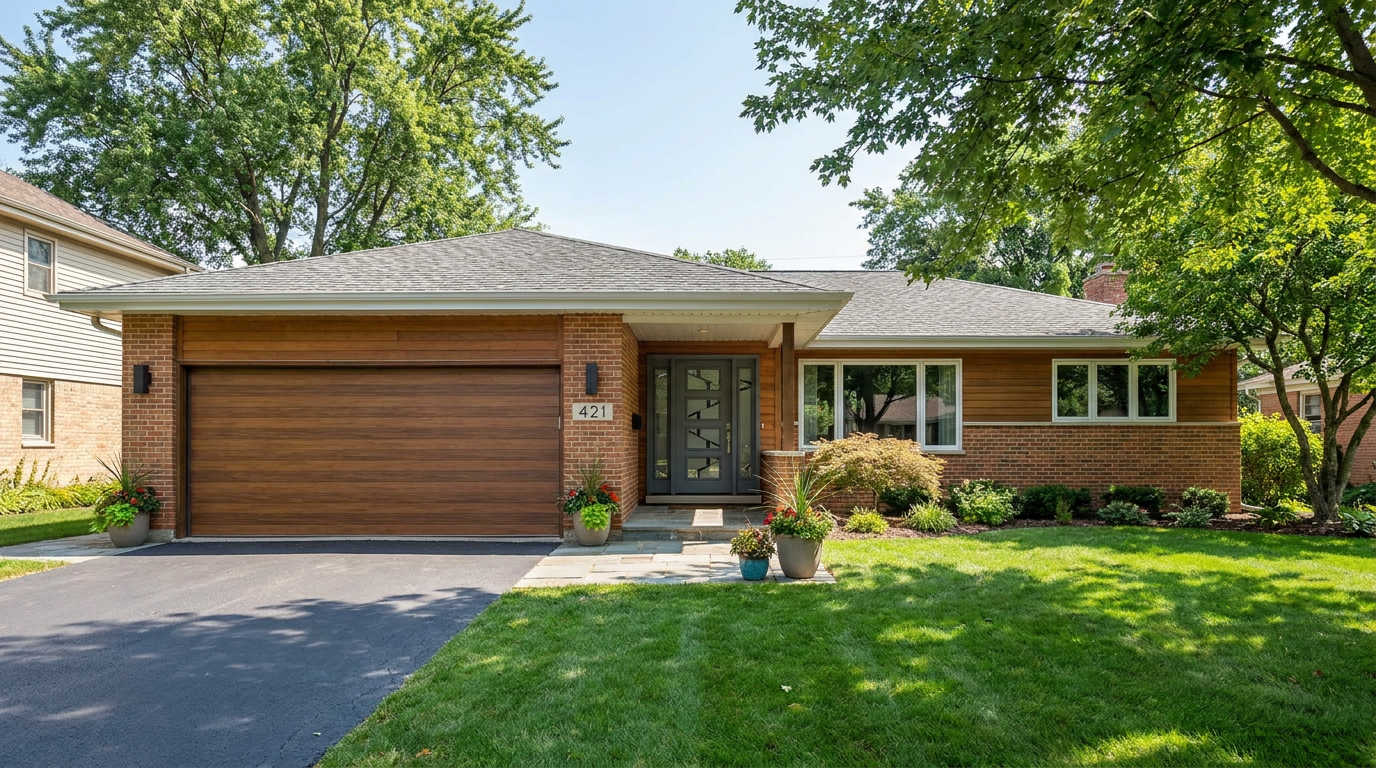
Because roughly 72% of Western Springs homes were built before 1970, the highest-return projects here are envelope and curb-appeal work — garage doors, entry doors, siding, and windows — rather than the interior overhauls that national renovation guides typically recommend. The reasoning is specific to the housing stock, and getting it wrong is expensive.
Why the housing stock changes the math
Return to the CMAP figures: median year built around 1960, 23.2% of units predating 1940, 48.8% built between 1940 and 1969. That is not a market of new construction with a scattering of older homes. It is a market of older homes with a scattering of new construction.
Now think about the buyer touring a 1958 colonial on a Sunday afternoon.
That buyer is not primarily evaluating whether they like the kitchen backsplash. They are running a risk assessment. They are asking how old the roof is. Whether those are original windows. What the furnace situation looks like. Whether the siding is at the end of its service life. Whether they are about to inherit a five-figure envelope project in year two of ownership, on top of a mortgage at current rates.
That anxiety is priced into their offer whether or not anyone names it out loud.
Which is why envelope work performs differently on older stock than the national averages suggest. A new garage door, a solid entry door, updated siding, replaced windows — these read to a buyer as risk removed. They are visible, immediate, verifiable evidence that the expensive and disruptive items have been handled. The buyer stops mentally subtracting for deferred maintenance and starts evaluating the house on its merits.
Interior finishes are a different transaction. They are taste-dependent, and taste is not universally shared. A buyer may love your quartz selection or may quietly plan to replace it. But nobody tours a house and thinks I wish this had older windows. Envelope work is the rare category where the improvement is legible to essentially every buyer in the pool.
The projects, with recouped-cost ranges
These are published as ranges rather than single figures, because that is what the data supports. Any source giving you a precise decimal on renovation ROI is manufacturing false confidence.
- Garage door replacement — roughly 90–95% of cost recouped. The most reliable return available on older stock, and frequently the single largest visual element on the front elevation.
- Steel entry door replacement — consistently top-tier curb appeal ROI, at a cost low enough that the return math is difficult to get wrong.
- Manufactured stone veneer or fiber-cement siding replacement — strong performers, particularly on homes where existing siding is visibly at end of life.
- Window replacement on original, drafty units — roughly 75–80% recouped in the Chicago region, with the added benefit that the improvement is felt every January.
- Minor kitchen remodel — roughly 70–85% in premium price tiers. Note carefully: minor. This is a refresh, not a gut renovation.
- Wood deck addition — a solid contributor where the lot and floor plan actually support outdoor living.
Two observations about that list. First, the top performers are inexpensive relative to interior renovation — a garage door is not a $90,000 commitment. Second, the highest-ROI projects are almost entirely visible from the street, which is to say they are working on the buyer before that buyer has walked through the door.
The over-improvement warning
This is the most counterintuitive advice in this guide, and the advice most likely to save a Western Springs homeowner a significant sum.
You can absolutely spend $150,000 on a renovation that adds $60,000 in market value. It happens regularly, it happens to careful people, and it almost always happens the same way: the finishes were selected for a price tier the house does not occupy.
With a detached median near $995,000, Western Springs is unambiguously a premium market — but “premium” is not one tier, it is several, and the difference between them is where money gets destroyed. A kitchen specified for a $1.6 million home does not return its cost when it is installed in a house sitting on a $900,000 block. The appliance package alone can absorb the entire realistic value gain. The buyer touring that house is comparing it to other houses in its comp set, and the marginal buyer will not pay a $1.6 million premium to live on a $900,000 street. They will simply buy the $1.6 million house.
The discipline this requires is unglamorous: know your comp set before you pick finishes. Not the village median — your actual comparable tier, on your actual block, for your actual house type. Then specify to the top of that tier and stop. The goal is to be the best house in your comp set, not a house that has wandered into somebody else’s.
This is also the clearest illustration of what a knowledgeable agent contributes before a single dollar is spent. Establishing the comp tier is a valuation question, and it is worth getting a defensible read on value before committing to a scope of work rather than discovering the ceiling afterward. Reversing that sequence is one of the more expensive mistakes available to a homeowner.
Compass Concierge, described accurately
For homeowners preparing to sell, Compass Concierge fronts the cost of pre-listing improvements — painting, flooring, staging, landscaping, lighting, and select kitchen and bath work — with zero upfront cost to the seller and no interest under standard terms.
Here are the repayment triggers, stated plainly, because this deserves to be understood rather than glossed. Repayment becomes due at the earliest of:
- The home selling,
- Termination of the listing agreement, or
- 12 months after the improvements are funded.
Terms vary by state, and late fees may apply.
This is not free money, and describing it that way would be a disservice. It is a deferral of cost, structured so that improvement work can happen before listing rather than being deferred until after a homeowner has already absorbed a price reduction. That timing is the actual value — the pre-listing window is when improvements do their work, and it is precisely the window when many sellers are least liquid, having not yet accessed the proceeds of the sale.
Used well, it converts the forced-equity lever from a theory into something executable. Used carelessly — with an unrealistic scope or an unrealistic timeline — it is an obligation with a clock. The sellers who have found the process most useful, as past clients have described, are those who scoped tightly against the comp tier and listed on schedule.
If you want the credential context behind that advice rather than a recitation of designations, it is on the about page.
Building equity is one half of the equation. The other half is what you can actually do with it — particularly without disturbing a mortgage rate you may have no interest in giving up.
How to Use Your Equity Without Refinancing — and Where Extra Payments Really Rank
If you want to access home equity without refinancing, you generally have options that leave the first mortgage entirely untouched: selling and redeploying the equity, borrowing against it through a second-position product, or simply holding while the market does the work. Which one fits depends on a single clarifying question — whether your goal is to access cash or to move.
That question matters more than it sounds, because a great many homeowners researching how to get equity out of your home without refinancing are actually contemplating a move and have not yet framed it that way.
The option most people overlook: sell and redeploy
For a homeowner sitting on substantial appreciation, the cleanest and least expensive way to access equity is to convert it — by selling.
This option gets systematically underweighted in discussions of home equity, largely because the conversation is usually framed around borrowing. But selling is the only path that accesses equity without adding debt service. No second payment, no variable rate exposure, no additional lien. The equity converts to cash at closing, and it is genuinely yours.
The local logic here is specific and it recurs constantly in Western Springs. Empty nesters occupying 1960s colonials with four bedrooms they no longer use, maintaining a house scaled to a household that has moved on. Families who have outgrown a home they bought in a very different phase of life. Owners relocating out of the region entirely who are sitting on years of accumulated appreciation.
For every one of those situations, the equity is not theoretical. It is the down payment on the next chapter, or the funding of a retirement, or the thing that makes a move financially straightforward rather than fraught.
And timing is not neutral. A strong seller’s market is when equity converts most efficiently — when the spread between what you receive and what you pay for the next property works in your favor, and when the transaction itself is least likely to be complicated by extended market time. With detached homes closing at 102.2% of list price on average over the trailing year, current conditions have favored well-prepared sellers. If a move is on your horizon within a couple of years, the question of when deserves as much thought as the question of whether. Reviewing current listings is a reasonable first step toward understanding what redeployment would actually look like across the western suburbs, and the pre-qualification conversation clarifies purchasing capacity on the other side of the sale.
Second-position borrowing, in one honest paragraph
Financial products exist that allow a homeowner to borrow against equity while leaving the first mortgage in place — a home equity loan and a home equity line of credit are the two most commonly referenced. Terms, rates, qualification standards, draw periods, and repayment structures vary substantially by institution and by borrower profile, and they change with rate conditions.
That is the extent of what belongs in a real estate guide. Colleen is a licensed broker, not a mortgage lender, and product-level comparison is genuinely outside that lane. If second-position borrowing is the direction you are considering, that conversation belongs with a qualified mortgage professional who can evaluate your actual credit profile, income documentation, and existing loan terms. Anyone offering you a confident product recommendation without that information is not in a position to make one.
Timing the sale matters more than most people expect
When equity converts at closing, the amount that actually reaches you depends on terms that were negotiated well before that day. Contract mechanics are not administrative trivia — they are the last mile of equity protection, and a homeowner who does not understand them can watch value evaporate in the final weeks of a transaction.
One example worth understanding in detail: the 72-hour clause, a provision that appears regularly in contracts with home-sale contingencies and that materially affects a seller’s position. It is explained in full in this breakdown of what a 72-hour clause is, and it is a useful illustration of how much protection lives in language most sellers skim.
Where accelerated paydown actually ranks — and why it is still worth doing
Now let us close the loop opened back in the levers section.
Extra principal payments do real work. They reduce total interest paid across the life of the loan, and on a thirty-year mortgage that reduction can be substantial. They accelerate the path to 20% equity and the removal of PMI. They build a buffer against markets that do not always move upward. And they deliver something the spreadsheet does not capture: the genuine satisfaction of watching a balance decline, which sustains good financial behavior over years in a way that optimization alone rarely does.
None of that is trivial, and this is not an argument for skipping them.
But hold the comparison steady. Against roughly $116,000 of appreciation over twelve months, a few thousand dollars of accelerated principal is not the headline. The point is proportion, not dismissal. Extra payments are a supporting move within a strategy, and treating them as the strategy itself means spending your attention on the smallest of the four levers while the largest ones go unaddressed.
So here is the sequencing that follows from everything above:
- Appeal the assessment first — it has a deadline, and the deadline is this month.
- Direct any resulting tax savings toward principal — this converts the second lever into the fourth automatically, without requiring new money from your household budget.
- Scope renovation against your actual comp tier, not against national averages or your own preferences.
- Let appreciation compound, understanding that it is the largest contributor and the one you influence least.
That order is the entire argument of this guide, compressed into four lines. Every decision above depends on knowing what your home is genuinely worth today, which is why a defensible valuation is the input rather than an afterthought.
Colleen is a licensed real estate broker, not a mortgage lender. Financial product decisions belong with a qualified lending professional.
Now let us consolidate all of this into the direct questions Western Springs homeowners actually ask.
Western Springs Home Equity FAQ
How much equity do I have in my home?
Your home equity equals your home’s current market value minus every debt secured against the property. On a $900,000 Western Springs home with a $540,000 mortgage balance, equity is $360,000 — a 60% loan-to-value ratio and a 40% equity position. The difficult input is market value, which an online estimate approximates but does not establish; a professional valuation provides a figure defensible enough to support an appeal, a renovation budget, or a listing decision.
How do I calculate home equity?
Subtract every lien on the property from its current market value. That includes the first mortgage plus any second mortgage, home equity line of credit, contractor’s lien, tax lien, or judgment attached to the home — homeowners frequently overstate equity by forgetting a second-position balance. The resulting figure is your equity; dividing your total balance by market value gives your loan-to-value ratio.
How can I get equity out of my home without refinancing?
Two primary paths leave a first mortgage untouched: selling the property and redeploying the proceeds, or borrowing against the equity through a second-position product. Selling is the only route that accesses equity without adding debt service. Second-position borrowing terms and qualification standards vary substantially by lender, so those specifics belong with a qualified mortgage professional rather than a real estate guide.
How fast does home equity build in Western Springs?
The trailing twelve-month median sale price for a detached Western Springs home was $995,000 through July 2026, up 13.2% year over year according to MRED MLS closed-sale data — roughly $116,000 of appreciation over twelve months without the owner taking any action. That figure describes what the market did in a specific twelve-month period. Past appreciation does not predict future results, and values can decline as well as rise.
Can I still appeal my Cook County property taxes after the Assessor deadline?
Yes. The Cook County Assessor’s Lyons Township deadline was September 3, 2026, but the Cook County Board of Review is an independent body with a separate window running August 31 through September 29, 2026 for Lyons Township. You may file with the Board of Review even if you never appealed to the Assessor. Appeal windows are township-specific and change annually, so verify current dates on the official Cook County calendars before relying on them.
What is the median home price in Western Springs, IL?
The trailing twelve-month median sale price for a detached single-family home was $995,000 through July 2026, up 13.2% year over year, per MRED MLS (ConnectMLS) closed-sale data. The July 2026 single-month median reached $1,000,000, crossing seven figures — though with only 189 detached sales across the full year, single-month figures are volatile and should be read as milestones rather than trends. Detached homes sold at 102.2% of list price on average.
Does a kitchen remodel increase home value in Western Springs?
A minor kitchen remodel recoups roughly 70–85% of its cost in premium price tiers. A major remodel that over-improves relative to neighboring comparable sales typically does not — finishes specified for a $1.6 million home will not return their cost in a $900,000 comp set. Establish your actual comparable tier before setting a renovation scope.
How long does it take to build 20% equity?
It depends on your down payment, your loan’s amortization schedule, and market appreciation. On a $900,000 home, 20% equity means a mortgage balance at or below $720,000. Appreciation can carry a homeowner across that threshold considerably faster than payments alone, since the ratio moves when either term changes — so it is worth recalculating rather than assuming. PMI removal rules vary by loan type and servicer.
What is the property tax rate in Western Springs?
The effective property tax rate in Western Springs runs roughly 1.45% to 1.60%. West Cook News reported a median annual tax bill of $14,354 against a median home value of $875,000 in Q4 2025. The effective rate reflects the combined levies of all taxing bodies serving the property, and individual bills vary with assessed value and applied exemptions.
Is Western Springs a good place to buy a home?
GoBankingRates ranked Western Springs the #1 safest and richest city in the United States in 2025, evaluating average household income, home values, cost of living, and property and violent crime rates. The village contains roughly 4,544 housing units, about 89% of them detached single-family homes, with a median year built around 1960 and limited new construction — only about 8.7% of stock was built in 2010 or later. That constrained supply shows up in the transaction record: just 189 detached homes closed in the trailing twelve months through July 2026, at an average of 102.2% of list price.

The Sequence That Actually Builds Equity Faster
The hierarchy is the whole lesson. Appreciation is doing the heaviest lifting in Western Springs and you influence it least; a property tax appeal is the fastest thing genuinely within your control and the only lever with an expiration date; targeted renovation is the lever you own outright, provided you scope it against your real comp tier rather than an aspirational one. Extra mortgage payments are a supporting move — worth making, and not the strategy.
Four actions, in order:
- Verify the Board of Review window and file before September 29, 2026 if your Lyons Township assessment looks indefensible against recent comparable sales.
- Confirm the Homeowner Exemption is actually applied to your bill, along with any senior exemption you qualify for.
- Establish a defensible current value — every other decision here depends on that input.
- Scope any pre-listing work against your actual comp tier, before committing budget.
The uncomfortable insight underneath all of it is that the most valuable thing on this page is not a strategy. It is a date. Strategies keep. The Board of Review window does not, and a homeowner who reads this in October will have lost the single most actionable item in it through nothing but timing.
Colleen Wilcox is a second-generation Illinois real estate professional, a Fortune Magazine Award winner for Top Client Satisfaction, and a Chicago Magazine 5-Star Agent nearly a decade running, serving Western Springs, Hinsdale, Burr Ridge, and Oak Brook.
General information only. Not legal, tax, accounting, or lending advice. Market data sourced from MRED MLS (ConnectMLS) and the FHFA House Price Index as of the dates cited; all figures change over time. Appeal windows are township-specific and must be verified against official Cook County sources. No outcome is guaranteed. Equal Housing Opportunity.
Know Your Number
Every lever in this guide depends on one input: a defensible read on what your home is actually worth. You cannot appeal an assessment, calculate your equity, or scope a renovation without it. Request a home valuation, or call or text (630) 291-9289. Office: One Grant Sq. #201, Hinsdale, IL 60521.
Considering a sale within the next twelve months? Compass Concierge can fund pre-listing improvements with no upfront cost, repayable at the earliest of the sale, termination of the listing agreement, or 12 months after funding.
Illinois Real Estate — The Best MOVE You Will Ever Make.